How We Grew an Apparel Brand's Revenue 70% with Performance Max
Vasant Chaudhary
Google Ads specialist. $30M+ managed across 50+ e-commerce and agency accounts in the US, UK and India. Book a free audit call
On this page
Short version: We grew a USA apparel brand's revenue by 70% to $380K in six months while lifting ROAS to a 9.09x conversion value/cost ratio, mainly by segmenting Performance Max by price and giving top collections their own campaigns. Here is how, and what it means for your catalog.
Once a store is established and has data depth, the game changes. You are no longer hunting for traction, you are looking for the hidden pockets of efficiency that a one-size-fits-all campaign buries. This brand had been managed since August 2022 and wanted more revenue and better ROAS. The answer was in how the catalog was structured inside Performance Max.
The situation
A USA brand specializing in Japanese loungewear wanted to increase revenue and improve ROAS at the same time, which usually feels like a trade-off. Their account already had strong data, but a single broad Performance Max campaign was treating a $40 item and a $200 item the same way. That is rarely optimal.
What we actually did
Segmented Performance Max by price. We split the catalog so budget could be weighted toward higher-priced products, which carry more margin and lift account-level ROAS.
Gave top collections their own campaigns. The best-performing collections got dedicated PMax campaigns so their budget was not diluted by weaker products.
Tested broad match in the brand campaign. Because the account had real data depth, we could safely test broad match keywords in the brand campaign and let Smart Bidding use the history to stay efficient.
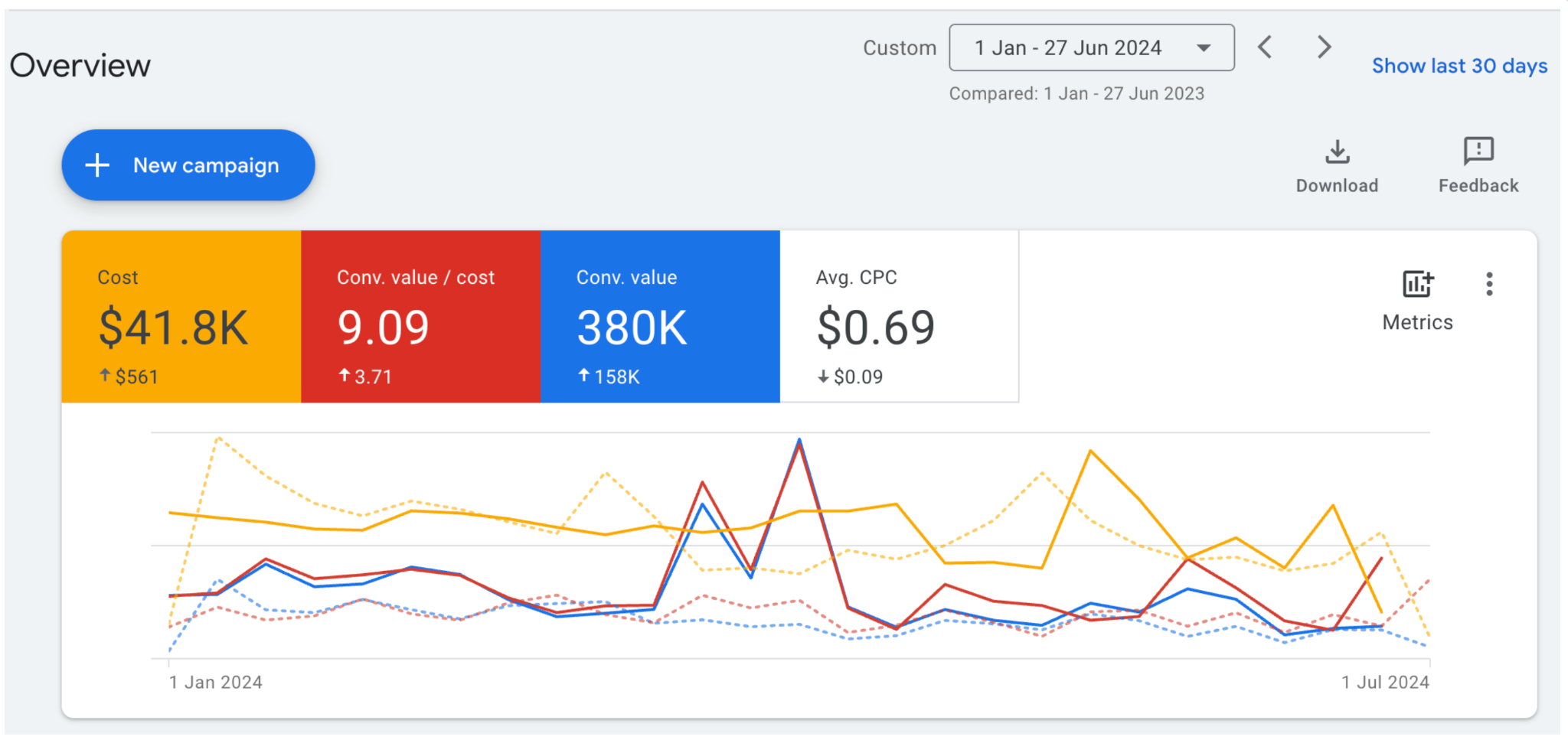
Google Ads account overview - Jan 1 to Jun 27, 2024
The results
Jan to Jun 2024 vs. the prior year: revenue up 70%, reaching $380K.
ROAS up 70% to a 9.09x conversion value/cost ratio.
Spend held nearly flat ($41.8K, up just $561) while average CPC fell to $0.69. More revenue, barely more cost.
How to structure Performance Max for a multi-price catalog
The principle behind this result applies to almost any store with a varied catalog. Here is how to think about Performance Max structure so it works for you instead of against you.
Why one big PMax campaign underperforms
Performance Max optimizes for conversions across your whole feed. Left as one campaign, it will naturally chase the easiest sales, usually your cheapest, highest-volume products. That can look fine on conversion count while quietly starving your high-margin items of budget. The single campaign averages winners and losers into one mediocre number, and you lose the ability to steer.
Segment by what changes your economics
The most useful way to split Performance Max is by something that genuinely changes profitability, most often price tier or margin. Group your products into low, mid, and high price bands, give each its own campaign, and set targets appropriate to each. Now you can deliberately push budget toward the high-AOV, high-margin band instead of letting the algorithm default to cheap volume.
Give your hero products their own stage
Your best-selling collections deserve dedicated campaigns so their budget is never diluted by weaker products. This also lets you set more aggressive targets on proven winners while keeping experimental products in a separate, lower-priority campaign.
Use the data depth you have earned
An established account with months of history can do things a new account cannot, like testing broad match in the brand campaign and trusting Smart Bidding to stay efficient. The longer your account has run cleanly, the more aggressive your testing can safely become. Data depth is an asset most brands never fully use.
What this means for your store
If you sell products across a range of prices, a single Performance Max campaign is probably leaving money on the table. Segmenting by price (and giving your hero collections their own campaigns) lets you push budget toward what actually drives profit instead of averaging everything together. The fact that spend stayed flat while revenue jumped 70% shows this is about efficiency, not just spending more.