How Price-Segmented Performance Max Grew a Pen Brand 80%
Vasant Chaudhary
Google Ads specialist. $30M+ managed across 50+ e-commerce and agency accounts in the US, UK and India. Book a free audit call
On this page
Short version: We grew a USA branded-pen brand's revenue from ~$100K/month to over $240K/month (80%+ growth) while improving ROAS 15%, using price-segmented Performance Max and dedicated assets-only campaigns. Here is the approach.
When a store sells products across very different price points, treating them all the same inside one campaign quietly caps your growth. This stationery brand had that exact issue, and fixing it unlocked both more revenue and better ROAS at the same time.
The situation
A USA stationery brand selling branded pens across multiple price ranges wanted to grow revenue while holding or improving ROAS, and to capture conversions from both shopping and non-shopping networks, which most accounts ignore entirely.
What we actually did
Three PMax campaigns segmented by price range. We weighted a larger budget toward high-priced pens to lift average order value and ROAS, instead of letting cheap products eat the budget.
Assets-only campaigns for the non-shopping networks. Separate no-feed, assets-only campaigns captured conversions on Search, Display, and YouTube that a feed-only setup would miss.
Prospecting on YouTube and Display. We added top-of-funnel campaigns to build brand awareness and feed the remarketing pool.
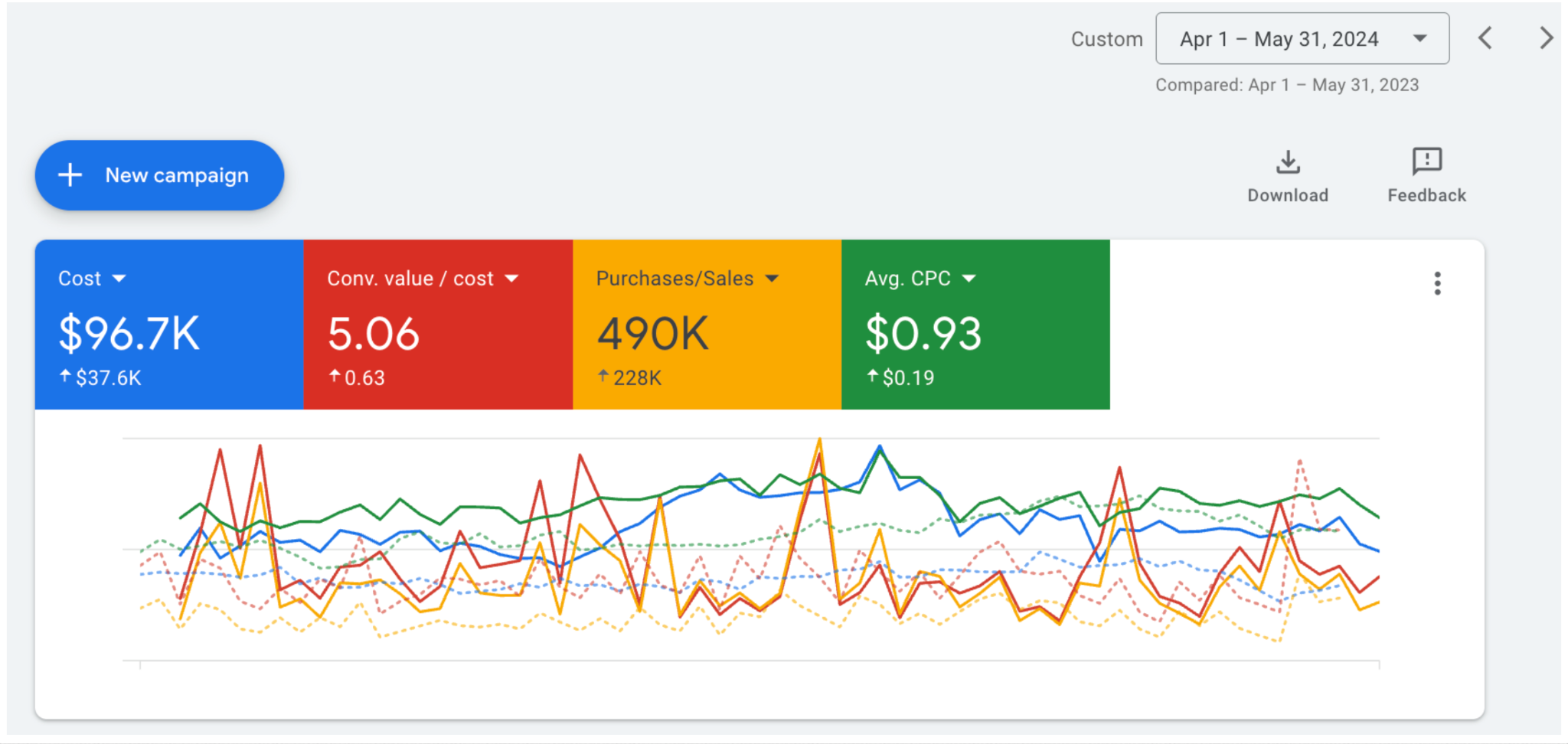
Google Ads account overview - Apr to May 2024 vs. prior year
The results
Started Oct 2021 at ~$100K/month revenue, growing to over $240K/month by May 2024 (revenue up 80%+).
Apr to May 2024 vs. prior year: $490K in sales (up $228K) at a 5.06x conversion value/cost ratio, a 15% ROAS improvement.
How to capture every network, not just Shopping
Most e-commerce accounts live and die by their product feed and never touch the rest of Google's inventory. That is a missed opportunity, and closing it was a big part of this brand's growth.
Add assets-only campaigns for non-shopping demand
A standard Shopping or feed-based Performance Max campaign only serves where your product feed can show. By running separate assets-only campaigns (no feed, just images, headlines, and descriptions), you capture conversions across Search text ads, Display, and YouTube that a feed-only account never reaches. For many stores this is genuinely incremental revenue, not cannibalized sales.
Use the upper funnel to feed the lower funnel
Prospecting on YouTube and Display does two things: it builds brand awareness, and it fills your remarketing audiences with people who will convert later at a much better cost. Brands that only run bottom-of-funnel Shopping eventually hit a ceiling because they are fishing in the same small pool of in-market buyers. Feeding the top of the funnel keeps that pool growing.
Weight budget toward margin, not just volume
Segmenting Performance Max by price band let this brand deliberately favor higher-priced pens, lifting average order value and ROAS together. The lesson generalizes: budget should follow profit, and that rarely happens automatically inside a single broad campaign.
What this means for your store
Two lessons. First, if you sell across price tiers, segment Performance Max by price so you can deliberately push budget toward your higher-margin products. Second, do not ignore the non-shopping networks: assets-only campaigns capture Search, Display, and YouTube conversions that a feed-only account leaves on the table. Together, these lifted revenue 80% and ROAS 15% at the same time.
Want this kind of structure for your catalog? Book a free audit call to talk it through. For agencies that want this kind of structure delivered under their own name, read our guide to white label Google Ads agencies.