Gun Accessories Google Ads Case Study: $180K to $400K a Month
Vasant Chaudhary
Google Ads specialist. $30M+ managed across 50+ e-commerce and agency accounts in the US, UK and India. Book a free audit call
On this page
The monthly revenue line for this USA gun holster brand had looked the same for a long time: around $180,000 a month, month after month. Not falling, not growing. Despite consistent effort, the account could not scale spend or conversions. Meanwhile competitors were bidding on the brand's own name, pushing up the cost of traffic that should have been the cheapest in the account.
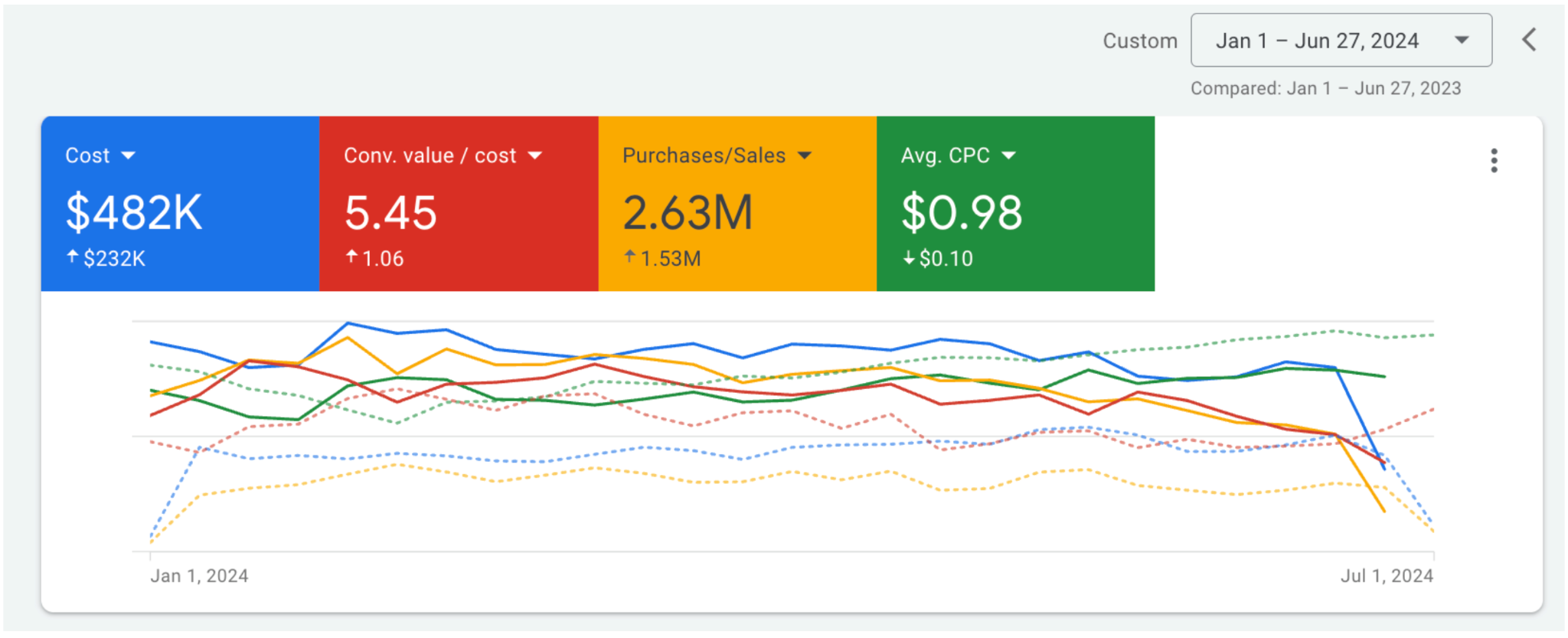
Short version: This gun accessories Google Ads case study is about a plateau that was caused by structure, not by effort. One Performance Max campaign was doing every job at once, brand and non-brand traffic were blended into one number, a device gap and a tight target CPA were throttling brand search, and converting search themes were hidden inside PMax. We separated brand from non-brand, split PMax by product category, split brand search by device and built Search campaigns from PMax's own data. Revenue grew from about $180K a month (October 2021) to more than $400K a month by May 2024. For January to June 2024 against the same period of 2023, sales were $2.63M (up $1.53M) at a 5.45x conversion value to cost ratio (up 1.06), while average CPC fell to $0.98.
Below is the full breakdown: what the account looked like, what was wrong, what we changed and in what order we recommend doing it, the results with dates, and what another store can copy. The brand is not named; we never name clients in our case studies.
Gun accessories Google Ads case study at a glance
~$180K to $400K+Monthly revenue, October 2021 to May 2024
$2.63MSales, Jan to Jun 2024, up $1.53M on the same period of 2023
5.45xConversion value to cost, up 1.06 year on year
$0.98Average CPC, down $0.10 while spend grew
The starting situation in this Google Ads case study
A store stuck at the same revenue for years
The brand is a leading USA holster company selling online. It had been running Google Ads with consistent effort behind it. The account was not declining; it had simply stopped growing. More budget did not buy more sales at an acceptable return, and nobody could point to why.
Competitors bidding on the brand name
Rival sellers were bidding aggressively on the brand's own terms. Branded searches are usually the cheapest, highest-converting clicks a store has, because the person already wants you. When competitors bid on them, those clicks get more expensive, and if brand traffic is mixed into other campaigns it becomes hard to even see what is happening.
What was actually wrong in the holster account
When an account plateaus, the first instinct is to blame bids or budget. In this gun accessories Google Ads case study, the real causes were four structural problems that fed each other.
One Performance Max campaign doing every job
A single broad PMax campaign held the whole catalogue. It served brand searches and non-brand searches, best sellers and slow movers, all under one budget and one target. Performance Max puts budget where it finds the easiest conversions, and the easiest conversions in any store are people searching the brand name. So the campaign looked efficient while quietly starving the non-brand prospecting that a store needs to grow.
Brand traffic hiding the true cost of new customers
Because brand searches were blended into PMax and Shopping, the account's ROAS was an average of cheap returning-customer sales and expensive new-customer sales. A healthy blended number hid a weak prospecting number underneath. You cannot scale what you cannot see, and the true cost of acquiring a new customer was invisible.
A device gap inside brand search
Brand search CPCs were very different on desktop and mobile. With both in one campaign under one target, the bidding could not price each correctly, so one device was overpaid and the other underbid.
A target CPA acting as a handbrake
The brand campaign ran on a target CPA that was too tight. When a target is set too aggressively, Google does not break it; it simply shows the ads less. That throttled the cheapest traffic in the account at the exact time competitors were trying to take it.
The common thread
None of these four problems show up as an error in Google Ads. The campaigns were all "working". The plateau came from campaigns doing several jobs at once, so no single job could be bid, budgeted or measured properly.
What we changed, in the order we recommend
This Google Ads case study comes down to four changes. Here they are in the order we recommend any store follows, with the reason each one comes where it does. Each step makes the next one measurable.
Separate brand from everything else. We launched a dedicated PMax Brand campaign and excluded brand terms from all other PMax and Shopping campaigns. This comes first because every later decision depends on seeing non-brand performance on its own.
Split brand search by device and loosen the target. With the desktop and mobile CPC gap and the restrictive target CPA identified, brand search was split by device so each could be bid correctly, and the target was no longer allowed to throttle the cheapest traffic in the account.
Segment PMax by product category. The single broad PMax campaign was split into several campaigns built around the top-performing product categories, so budget followed the winners instead of being averaged across the whole catalogue.
Build Search campaigns from PMax's own data. We took the converting search themes that PMax surfaced and built dedicated Search campaigns around them, turning hidden insight into campaigns with their own keywords, ads and budgets.
Why brand separation comes first
Until brand is separated, every other number in the account is distorted by it. Category PMax campaigns would still look good or bad partly because of how much brand traffic they happened to catch. Once brand lives in its own campaign, you can judge each non-brand campaign on what it actually does: find new customers.
Why category segmentation beats one big PMax
One PMax campaign averages strong and weak categories into one target. Splitting by category lets the strong categories take more budget at a target that suits their margins, and stops a few best sellers from hiding the rest of the catalogue. We used a similar idea, split by price instead of category, in our price-segmented PMax case study for a stationery brand.
Why Search from PMax insights adds control
PMax shows which search themes convert but gives you limited control over them. Moving the proven ones into Search campaigns gives you keyword-level bids, specific ad copy and clean reporting on terms you already know work. Our comparison of PMax vs Search campaigns covers when each should own a query.
The results of the gun accessories Google Ads case study
Google Ads account overview - Jan to Jun 2024 vs. prior year
This is the evidence behind the gun accessories Google Ads case study. The screenshot compares 1 January to 27 June 2024 with the same dates in 2023. Working back from the changes shown gives the before and after below.
Metric
Jan to Jun 2023
Jan to Jun 2024
Change
Cost
About $250K
$482K
Up $232K
Purchases / sales value
About $1.10M
$2.63M
Up $1.53M
Conversion value / cost
About 4.39x
5.45x
Up 1.06
Average CPC
About $1.08
$0.98
Down $0.10
Monthly revenue grew from about $180K in October 2021 to more than $400K by May 2024, more than doubling in under three years.
Spend nearly doubled year on year, and return on that spend still went up, from about 4.39x to 5.45x.
Average CPC went down while spend went up, which usually means more budget is reaching cheaper, better-matched traffic rather than bidding harder on the same clicks.
Why these Google Ads changes worked together
Scaling usually costs efficiency: you spend more, and each extra dollar returns a little less. Here spend nearly doubled and ROAS rose at the same time. That is unusual, and it points to structure rather than bidding. Once brand stopped propping up the averages, budget could be moved to the categories and search themes that genuinely produced new customers. Once those had their own campaigns, each could be pushed as far as its own return allowed, instead of being held back by the weakest part of the catalogue.
The falling CPC tells the same story. Brand search split by device stopped overpaying on one device. Search campaigns built from proven PMax themes bought clicks on terms that already converted. Neither required outbidding anyone.
What other stores can copy from this Google Ads case study
You do not need to sell holsters or gun accessories for this Google Ads case study to apply to you. The same pattern shows up in most stores with a known brand and a catalogue of more than a few categories.
Give brand its own campaign and exclude brand terms from every PMax and Shopping campaign. Then read your non-brand ROAS honestly, even if it is lower than you hoped.
Check brand search by device. If CPCs or conversion rates differ a lot between desktop and mobile, split them.
Test your target. If spend will not grow no matter what budget you set, loosen the target CPA or ROAS in small, controlled steps and watch what happens to volume.
Split PMax by what actually sells. Use category, price band or margin, whichever best separates your winners from the rest.
Mine PMax for Search. Pull the converting search themes and give the best ones their own Search campaigns.
What not to copy blindly
Splitting campaigns only helps if each new campaign has enough conversions to learn. A store with a small budget and few sales a week can make things worse by splitting too far. Start with brand versus non-brand, which almost always helps, and add category splits only where each one can stand on its own volume.
Is this you? A quick plateau checklist
If three or more of these describe your account, the problem is probably structure rather than budget, and the moves in this gun accessories Google Ads case study are a good place to start.
Revenue from Google Ads has been roughly flat for six months or more despite budget changes.
Your brand name is searched, but brand terms are not excluded from PMax or Shopping.
Your whole catalogue sits in one PMax campaign.
Competitors appear when you search your own brand name.
Raising the budget does not raise spend, or raises spend without more sales.
You have never looked at the search terms or search themes PMax is converting on.
You do not know your ROAS on new customers, only the blended number.
How to diagnose a plateaued Google Ads account
Plateaus almost always trace back to a handful of structural problems. When an account we inherit has stalled, these are the first things we check, and you can check them too.
Is brand traffic inflating your numbers?
If brand searches are mixed into your Shopping and Performance Max campaigns, your blended ROAS looks great while your real prospecting performance hides underneath. Separate brand into its own campaign and exclude brand terms elsewhere, and you will see the true cost of acquiring new customers, which is the number that actually limits scale.
Are your campaigns competing with each other?
Multiple Performance Max or Shopping campaigns that include the same products will compete for the same auctions. Each product should have one clear home. We saw the same internal conflict in our hardware store case study on PMax product conflicts.
Is a restrictive target throttling spend?
A target CPA or target ROAS set too aggressively will quietly cap delivery. If spend will not grow no matter the budget, your target is often the handbrake. Loosening it slightly, in controlled steps, frequently unlocks profitable volume.
Are you mining PMax for Search opportunities?
Performance Max surfaces converting search themes that you can turn into dedicated, controllable Search campaigns. Most accounts leave this unused. For a wider look at what PMax hides and how to read it, see our piece on the truth about Performance Max for ecommerce.
Frequently asked questions
How did this gun accessories brand double revenue with Google Ads?
By changing structure rather than bids. Brand traffic was moved into its own PMax Brand campaign and excluded from all other PMax and Shopping campaigns, brand search was split by device and freed from a restrictive target CPA, one broad PMax campaign was split by top product category, and Search campaigns were built from PMax's converting search themes. Monthly revenue went from about $180K in October 2021 to over $400K by May 2024.
Why does a Google Ads account plateau even when budget increases?
Usually because of structure. Brand traffic blended into prospecting campaigns hides the real cost of new customers, one large PMax campaign averages strong and weak products together, and a tight target CPA or ROAS stops Google from spending the extra budget. More budget cannot fix any of those; separating the campaigns can.
Should brand terms be excluded from Performance Max?
For most stores with a known brand, yes. Excluding brand terms from PMax and Shopping and running brand in its own campaign shows you how prospecting really performs and stops PMax from taking credit for people who were already searching for you. In this Google Ads case study it was the first change, and it made every later change measurable.
How long does it take to break a Google Ads plateau?
The structural changes can be made in weeks, but the growth compounds over months as each new campaign gathers data and budget moves to the winners. In this account, revenue more than doubled between October 2021 and May 2024, with the first half of 2024 alone up $1.53M in sales on the same period of 2023.
Does splitting Performance Max by product category work for every store?
Not always. Each new campaign needs enough conversions to learn, so stores with small budgets or few weekly sales should split carefully. Separating brand from non-brand helps almost every store; category or price splits help when each segment has its own steady volume.
Can gun accessory stores advertise on Google Ads?
Accessory stores can run Google Ads, but the category sits close to Google's dangerous products rules, so every product needs to pass policy review and some items may be restricted. Check your disapprovals in Merchant Center and Google Ads before working on structure, because nothing in this case study helps products that are not allowed to serve.
What this Google Ads case study means for your store
If your account has plateaued, the problem is usually not your bids, it is your structure. Brand and non-brand traffic blended together hides your real performance. One giant PMax campaign averages your winners and losers into mediocrity. Separating brand, segmenting PMax by category and building Search from PMax's own data are the moves that broke this plateau, and revenue doubled while CPC went down. You can see this gun accessories Google Ads case study alongside our other results on the case studies page.